Projects and Process
The latest update: The Morden Art Show Precis
For a more detailed explanation of the Hebrews 11 series, as well as some of my other paintings, please download and read For All The Saints (PDF), which contains more info than you can shake a stick at! Note: Acrobat Reader or equivalent required to view this file.
Hebrews 11… and some really big paintings!
(Reposted from my personal blog)
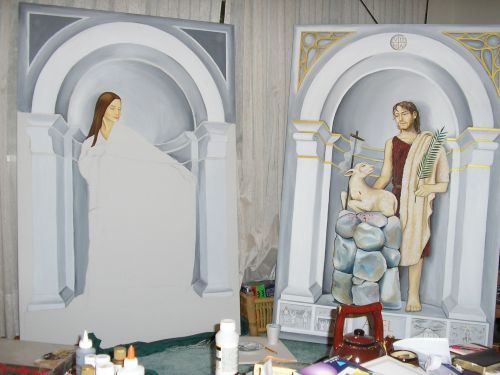
So, in my ongoing efforts to raise the level of Christian art form (i.e., bring back the liturgical, down with the cheapness!), I’ve been considering doing a series of 10 or more large paintings of various saints, using Hebrews 11 as my samples. This will include Abel, Enoch, Noah, Abraham, Isaac, Jacob, Joseph, Moses, Rahab, and a personified nation of Israel.
It is a very sorry reality that considering the examples of the saints who have gone before us, as the writer of Hebrews invites us to, is viewed as a “Roman Catholic” thing and is therefore avoided like the plague by many churches and even some Lutherans. Lutherans especially take the ancient church, the apostles and the church fathers and all those years before the Reformation, as our very own heritage, not something exclusive to Roman Catholicism. They did not want to scrap the whole history of Christendom and start again with their own church, but merely reform some errors that had gotten in the way of orthodoxy. Practices that were helpful in teaching about Christ and preserved church order, dignity and unity were to be retained; only practices that contained abuses were to be corrected.
That takes us to the issue of the saints. Clearly throughout the Middle Ages the cults of various saints, especially Mary, were running rampant. The idea that we must ask these saints to intercede for us before God in order to take advantage of their merit was one of the abuses that the Reformers spoke against. Yet instead of abolishing the saints or ignoring them as unimportant, the Lutherans instead encouraged the proper use of the memory of the saints. Namely, that they are given to us in Scripture (Hebrews 11 being a notable passage) as examples of God’s great grace extended to weak sinful beings like us, who trusted in God, being strengthened in their faith, and clung to his promises no matter what. This is bound to bring Romans 1:17 to mind for many, a text that partially inspired the Reformation: “The righteous will live by faith.”
In other words, we aren’t remembering these saints because they attained unusually high levels of pious holiness, or because they dispense some of their merit into our midst when we ask for favors, or because of their “victorious living.” They aren’t a hall of fame. They’re living testimonies of a faithful God, people who were strong when they were weak (11:34), called by God even though they were awful sinners, and are now in the holy city that they had been looking forward to in hope all their earthly lives (11:16). These people of faith–that faith which cannot help but be active– point us to Christ, where our faith is solely rooted. In all these things they are examples of comfort and hope for us all.
So, all this is to say that I’m planning my depiction of these saints in a thoroughly Lutheran manner. (I can hear the gasps of surprise.) ;o) That means these saints are going to be somehow represented with warts and all, coupled with the loads of sacramental and salvific imagery that permeates Hebrews 11 (the flood, the sacrifices, Passover, etc etc). In other words, the Law and the Gospel!!